Tuesday, December 29, 2009

Page Thirty-Three

The Book Thief by Markus Zusak

"I could introduce myself properly, but it's not really necessary. You will know me well enough and soon enough, depending on a diverse range of variables. It suffices to say that at some point in time, I will be standing over you, as genially as possible. Your soul will be in my arms. A color will be perched on my shoulder. I will carry you gently away" (4).

So begins the narrator's description of himself in this unique, 550-page young adult novel. Interesting in this case, the narrator is Death, who is omniscient, focussing particularly on the young life of Liesel Meminger - otherwise known as The Book Thief. Liesel has just lost her mother and brother and has arrived at Himmel Street, Molching, Nazi Germany. She stole her first book at the site of her brother's burial, and has decided that one is not enough after being introduced to words and reading by her foster father. Death watches her as she grows up with her beloved Papa, a cursing yet loving Mama, and best friend, Rudy.

This book was excellent, mostly for the unique perspective from which it is told. Death is ever-present, which is fitting considering the subject and time period of the novel. Particularly heartwrenching were the scenes scattered here and there throughout the book that told of Death's presence at scenes of such places as Stalingrad and Auschwitz: "Please believe me when I tell you that I picked up each soul that day as if it were newly born. I even kissed a few weary, poisoned cheeks. I listened to their last, gasping cries. Their vanishing words. I watched their love visions and freed them from their fear. [. . .] They were French, they were Jews, and they were you" (350).

As the war presses ever closer, Liesel's foster parents hide a Jew, Max, in their basement, and Liesel and Max create a strong bond based on Liesel's imagination and their common love of words.
This novel is an account of a German family's struggles in Nazi-occupied Germany, of growing up amid war, of friendship and love, of death, but mostly it is a book about the power of words, words that have the power to kill, heal, inspire, and comfort. As Liesel states, "I have hated the words and I have loved them" (528).

Friday, August 21, 2009

Page Thirty-Two

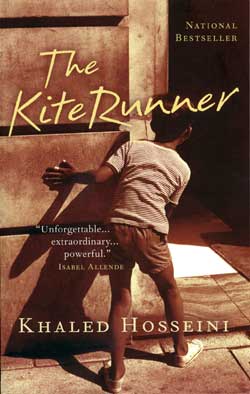
The Kite Runner by Khaled Hosseini

This was a re-read for me. I think I reacted to this book more the second time around, which was odd. I had remembered the main events, but the details, such as Hosseini's perfect description and startling imagery, and the emotional response the book evoked, had been forgotten or blurred, so I rediscovered those things all over again. I also read the book this time around with a much more critical eye, reading it more as a piece of literary achievement than simply a book to settle in to.
There are several merits to this book, most notably is the writing style of the author. He captures things so well, in one scene I literally felt ill as he described Amir's car sickness. But it is the flaws and fractures of Amir, the protagonist, that I think really makes this book. On one hand, I loathed Amir for his cowardice, his treatment of Hassan, his babyish fights for his father's affections; but, on the other hand, this is what makes this book and this character so riveting. It is inside these flaws and fractures that make the book and the people in it so real, for I'm sure many readers can put themselves inside the guilty conscience of a frightened and confused young boy. The relationship between Amir and his father was also particularly well developed, with Amir learning his father fell victim to sin just as he had, and was not as god-like as he had once believed.
This novel reminded me of a novel I have read and blogged about: On Chesil Beach. One moment, one action or inaction, can change the course of a life forever.

Monday, August 10, 2009

Page Thirty-One

The Help by Kathryn Stockett

It is the early 1960s in Jackson, Mississippi. The policy of "separate but equal" is in full, hypocritical swing. Jim Crow laws may have passed, but within the city is much racial tension, and dealing with "uppity" blacks who have done something to cross a white takes many horrific forms. Miss Skeeter, the white daughter of a plantation owner, is a frustrated young woman. She is quickly beginning to see she doesn't quite fit in with her racist, bridge-playing, married-with-children friends. While her friends are wrapped up in petty concerns and setting their black maids straight, she is trying to find herself as a writer and find a way out of her oppressive hometown. On a whim, she sends an idea to an editor in New York for an idea for a book: an expose on the lives of black maids in one of the most racially-heated cities in the South. So begins her clandestine meetings with Aibileen and Minny, opening her eyes to the truth of black and white relations. One by one other maids begin to step forward to share their stories, and the women must deal with the repurcussions of what may happen to them if the people of Jackson find out they are the main characters in Miss Skeeter's book.

The novel is made of up three different perspectives: Miss Skeeter, Aibileen, and Minny. Each character has her own distinct voice. Miss Skeeter is obviously a vague representation of the author herself; Aibileen is a caring, older woman mourning the loss of her own son, and moves from white home to white home once the white children she's reared stop being colourblind; Minny is an outspoken, larger woman with an equally large family and a drunken husband, whose devilish antics have her holding much of the suspense of the book.

I really enjoyed this book. Finally a book I read this summer that I actually didn't want to put down. Granted, it hinted at To Kill a Mockingbird in ways that were a bit obvious, but I appreciated the new perspective it gave, especially since it came from the author's own relationship and lingering questions with her black maid she had growing up in Jackson. I found myself truly detesting certain characters, and feeling bitterness at knowing there are people as ignorant - and more so - as those in the book, and the lengths people go to which stem from their own stupidity. But the book is also funny, and touching, and just makes for a good story.

Page Thirty

Shanghai Girls by Lisa See

It is pre-World War II and two sisters, Pearl - the narrator - and May, are young, beautiful, and living carefree in the vibrant city of Shanghai. Both sisters are naive and unaware of what is actually going on around them, so when they have to flee Shanghai with their mother, after discovering their father has left them deep in debt, they are forced to open their eyes to the world around them, as well as deal with the threat of the Japanese. After a difficult journey and losing their mother, Pearl and May end up in San Francisco and try to make a life for themselves, with their husbands whom they were forced to marry back in Shanghai before they fled. Their lives become separate, as Pearl works hard to keep the family afloat in a Chinatown family cafe and at home, and May becomes caught up in work for the film industry. Both, however, must deal with the consequences of the Communist-craze and inevitably turn to each other when all else has fallen apart.

I did not enjoy this book as much as See's other book I read, Snow Flower and the Secret Fan. While it kept my interest, it took me longer than normal to read it, which tells me it wasn't a great book. There were interesting parts along the way, and some particularly gruesome scenes, but overall I don't think I would recommend this book.

Monday, January 5, 2009

Page Twenty-Nine

The Guernsay Literary and Potato Peel Pie Society by Mary Ann Shaffer and Annie Barrows

I knew I had to read this book based on the title alone. I had also read fairly good reviews of it, and it sounded like something I would like, particularly as it is considered "historical fiction." The book is written as a series of letters between characters - mostly between the "main" protagonist, Juliet, and her book editor and newfound friends who are living in Guernsay. The setting is the immediate aftermath of World War II, England. Guernsay is one of the Channel islands. Events transpire and soon Juliet begins to write to different people in Guernsay and becomes fascinated with their life under German occupation during the war, and the literary society they created at this time as well: The Guernsay Literary and Potato Peel Pie Society. Juliet becomes wrapped up in their lives and stories, and decides to travel to Guernsay in attempt to write a story about their lives during the war.

I suppose I would characterize this book as "charming" or "quaint." It is a book that I see someone reading while sipping liesurely on a cup of tea and occasionally nibbling on a biscuit, pausing every once in awhile to raise an eyebrow or let out an "ooh" or "I wonder..." while turning the page. Inevitably, however, the book lacked literary chops. It was the author's first and only novel, and it showed.

Thursday, August 21, 2008

Page Twenty-Eight

Into the Wild by Jon Krakauer

I did something with this book I don't normally do: I watched the film version first. The film was done remarkably well by writer-director Sean Penn, so much so that it has become the most affecting movie I've ever seen. I couldn't seem to shake the story out of my head - the young, 23-year old Christopher McCandless, who, from 1990-1992, escaped society and the constraints of his parents to travel the American West, eventually leading to his final, greatest adventure: his Alaskan odyssey. Inspired by writers like London, Tolstoy, and Thoreau, McCandless planned to "live off the land," and, in April 1992, carried nothing into the unforgiving wild but some bare necessitities, including a .22 caliber rifle and a 10-pound bag of rice. Yet, as both the movie and Krakauer make clear, McCandless wasn't quite the ignorant, reckless kid many Alaskans and critics have made him out to be. As the author points out, McCandless would have had to have been knowledgeable enough to have lasted in the wild for as long as he did (approximately 4 months).

The movie follows McCandless's journey very accurately, give or take some select things. What the book offers more so than the movie, however, is a look at Chris's young self - who he was in high school, university, the people he hung out with, and how he had always "marched to the beat of his own drum." It also gets into more detail of the grief suffered by his family and those he met on the road after they learned of his death, and details some stories of Krakauer himself, and other travelers who met their ends in equally tragic ways. In doing so, Krakauer attempts to shed some reasoning behind why McCandless wanted a solitary life in the wilderness more than anything else.

What is it about this story that is so captivating? It could be knowing the ambition of McCandless - how he said he would do something, and he went after it, and yet perished; it could be his youth; it could be how he died; it could be the people he met and left behind who mourn him still. Or, maybe it's because we all have a bit of wanderlust in us, and wonder what it would be like to take to the road and live without items we have been told by society are "necessities" for our survival. Except, in our case, we don't actually follow through with it.

Yet, it wasn't a simple case of wanderlust that drove McCandless. It wasn't a passing thought, an act of rebellion. It was something spiritual. McCandless was drawn "past the edge of the known world, by nothing more than a hunger of spirit, a yearning of such queer intensity that it beggars the modern imagination" (97). Indeed, perhaps what makes the story so tragic in the end is that we can't fully understand it.

Friday, August 1, 2008

Page Twenty-Seven

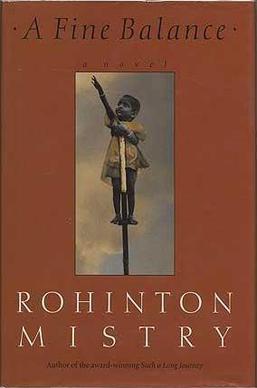
A Fine Balance by Rohinton Mistry

It is the mid-1970s and India is experiencing a major political upheaval. During this time, four people and their individual stories - Dina, Ishvar, Om, and Maneck - become linked together, much like the patchwork quilt that Dina sews from the scraps of material that build up in her small flat. Through much hardship, these four come to realize that the makeshift family they have created will bring the happiest moments in their lives.

This book was a fantastic read because of Mistry's ability as a storyteller. Each character and his or her story is carefully crafted, as are the connections he makes between certain things, such as the reapparance of characters like Valmik and Rajaram, and the quilting motif throughout a lot of the book. However, a major theme that makes up this book is fortune, or the lack thereof. Just when you think things are looking up for the characters, something terrible befalls them and you are left wondering how people can survive in such circumstances.

This is not a "happy" read, for the most part, but if you're looking to get lost inside a great story, read this book.

"Please always remember, the secret of suvival is to embrace change, and to adapt. To quote: 'All things fall and are built again, and those that build them again are gay.'"
"Yeats?" guessed Maneck.
The proofreader nodded, "You see, you cannot draw lines and compartments, and refuse to budge beyond them. Sometimes you have to use your failures as stepping-stones to success. You have to maintain a fine balance between hope and dispair. [. . .] In the end, it's all a question of balance" (268).