Tuesday, July 22, 2008

Page Twenty-Six

My Sister's Keeper by Jodi Picoult

I read this book after it was recommended to me by a couple of people. The premise was intruiging, and sounded like one of those "summer reads" you could get lost in for awhile. Anna is thirteen and her sister Kate is sixteen. Anna was conceived so that she could be a bone marrow match for Kate, who was diagnosed with leukemia when she was two. Anna has undergone multiple invasive medical treatments in order to help Kate fight her disease, and the novel opens with Kate in renal failure needing Anna to donate a kidney. Anna finds a lawyer to seek medical emanicpation from her parents so that she can finally have a say over her own body. The issues that surround this decision and the case that follows manages to sever the already fractured family in pieces.

The novel, even at 423 pages, is a quick read, as the subject matter keeps you engaged. Although, I think it was this very fact why I didn't like this book as much as I thought I would. Picoult jumps back and forth between narrative voice: Anna, Sara (mother), Brian (father), Campbell (lawyer), Jesse (son), Julia (still trying to figure out why she was really essential to the story). With the shifts in narrative voice also comes shifts in plot: Anna trying to find out who she is apart from her sister's saviour; Jesse, obviously plagued by guilt at not being able to save his sister, catapulting down a self-destructive path; and the oddly out of context relationship between Campbell (and his dog) and Julia. Because there are six different narrators in this book, I didn't feel Picoult accurately captured each of them. At times Anna sounded older than her confused, thirteen-year old self, and sometimes when I was reading the perspective of one character I'd forget who was speaking because the voices blended together ever so slightly. Each character also always had to end a section with something "profound," and I didn't think it always fit the character.

Ultimately, the book (and likely the forthcoming film version) will definately be a sob-fest for many, particularly if you yourself have a child. I think the character of Sara, the girls' mother, hits the nail on the head: "Ten years from now, I want to see your children on your lap and in your arms, because that's when you'll understand" (405). Readers with children beware: read only with a box of tissues.

Thursday, July 17, 2008

Page Twenty-Five

The Outcast by Sadie Jones

"It had started like any other Sunday. Like any other desperate, hate-filled, pointless Sunday in the stream of Sundays as long as he could remember. Everybody was out, everybody playing their parts in a play he didn't understand and didn't want any part of. There had been nothing to indicate how the day would end" (167).

It is 1957 in the South of England and 19-year old Lewis Aldridge is coming home from prison after two years. The reader is unsure of exactly why Lewis was in prison, and the novel returns to his boyhood to explain the events leading up to his arrest, which includes one disastrous event that changes the course of his life forever.

This book started out somewhat slow, and then became such a page turner I had to stay up all night to finish it. I think my anger at the adult characters in the book propelled me forward. First, Lewis' own father and his unwillingness to help Lewis through his grief as a child, then Lewis' stepmother who has a host of her own issues that precede helping her stepson, then the Carmichaels who I just loathed entirely.

This was the book I had been waiting to read this summer, and it definately delivered.

Monday, July 14, 2008

Page Twenty-Four

A Long Way Gone: Memoirs of a Boy Soldier by Ishmael Beah

This memoir tells of Beah's three years as a boy soldier for a government army in Sierra Leone. After three years of fighting, Beah was rehabilitated by UNICEF. He eventually went to New York City to speak about child soldiers, and finally escaped the war-ravaged Sierra Leone to permanently move to New York City.

I have been wanting to read this book ever since I first heard of it, but was a bit hesitant. The idea of children pumped up on drugs, brainwashed, and spending their days killing, pillaging, and being shot at is, of course, not an easy subject to swallow. However, I think it's important to understand the extent of what these children have to go through. The book is not an easy read; it is quite disturbing in parts. However, I would highly recommend it. I'm sure many people who hear about child soldiers wonder how it happens, how they become caught up in it, and this book definately answers those questions, and gives hope that these children find a way out if they are given a strong network of support.

While reading, I found it quite interesting how Beah's rap music cassettes that he carried in his pockets actually saved his life a couple of times. It was also quite humorous to read his account of arriving in New York City in the winter and seeing snow for the first time.

Friday, July 4, 2008

Page Twenty-Three

On Chesil Beach by Ian McEwan

After reading Atonement and realizing what a strong writer McEwan was, I decided to pick up this brief novel after hearing a few positive things about it. The premise is interesting: Edward and Florence, both in their early twenties in the early sixties, marry after a brief year together. The novel opens on the eve of their wedding night, and both have their own concerns as to what is to happen. The novel can be summed up in one poignant line: "This is how the entire course of a life can be changed - by doing nothing." McEwan is a master at this; in fact, the book cover notes how he is a master at "lives transformed by a gesture not made or a word not spoken." It makes his writing eerily pertinent to lives of readers who have, I am almost certain, made such mistakes themselves and then have come to regret them.

Monday, June 30, 2008

Page Twenty-Two

Midwives by Chris Bohjalian

Sibyl Danforth, a midwife in Vermont who only performs home births, makes a rash decision to perform an emergency C-section on Charlotte Bedford in order to save the life of her baby, after she believes Charlotte died in childbirth. The question is was Charlotte really dead? This question makes up the majority of the book, which is narrated by Sibyl's daughter, Connie, looking back to her 14-year old self and following the events of the trial that would decide her mother, and her family's, fate. The question is never fully answered, but I think the author allows readers to make up their own mind, based mostly on the pieces of Sibyl's journal we are allowed access to.

I enjoyed reading this book - it kept me interested, and Bohjalian keeps the reader dangling by a thread throughout the whole trial, using flashforwards and flashbacks to keep us wondering if Sibyl will be convicted or not. Yet, my response to the book was that it is not a must-read, but a pleasure read for a languid summer day.

Wednesday, January 2, 2008

Page Twenty-One

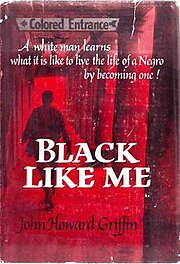
Black Like Me by John Howard Griffin

In 1959, journalist John Howard Griffin decided to find out what it was like for a black man living in the South. To do this, he took medication to darken his skin, exposed himself to ultraviolet rays, and applied a dark skin stain, and set out on a 7-week journey to different areas, including Mississippi, Alabama, and New Orleans. His first-hand account exposes the racist practices of the time, and leaves the reader feeling ashamed and disgusted.

Monday, December 31, 2007

Page Twenty

Atonement by Ian McEwan

The book begins in 1935, England. 13-year old Briony Tallis has a very vivid imagination, which is revealed in the short plays she writes to perform for her family. Briony reads a letter meant for her older sister, Cecilia, from Robbie, the son of the Tallis' servant, and also witnesses an encounter between the two of them. Her overactive imagination and misunderstanding of the situation sets in motion an accusation that unravels the Tallis family and changes the lives of everyone involved. The book moves forward five years into WWII, and then jumps ahead to 1999 briefly at the novel's conclusion.

This book is a nice challenge, because, to me, it is reminiscent of Virginia Woolf's writing. But readers beware: this book is also completely heartbreaking.